The Prime Law
of Networks

Why small packets, more connections, and relentless iteration always win.

V ∝ n² / p

Value grows as the square of connected nodes (n) and inversely with packet size (p). Drive p toward 1 and value explodes.

The Problem

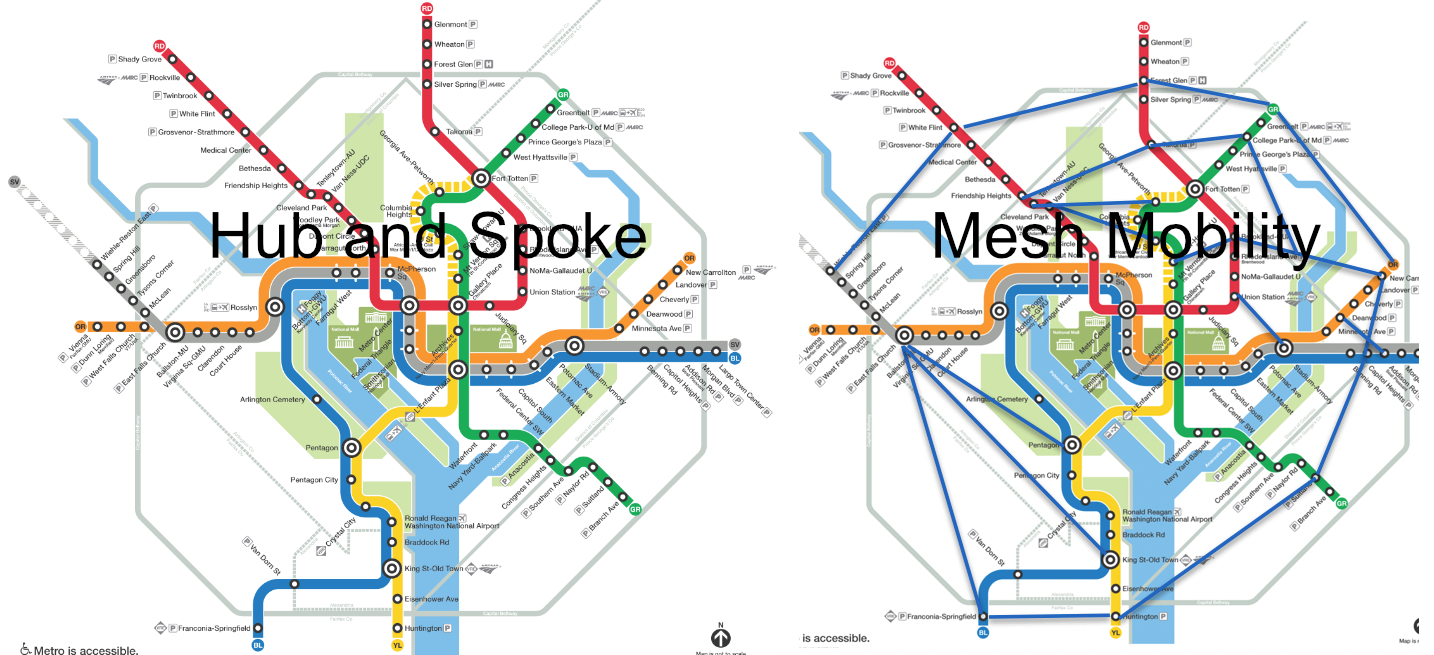
Every major transit system is hub-and-spoke. All lines converge downtown. Want to cross town? Ride to the center and back out. The hub is a bottleneck. The spokes are captive. Most origin-destination pairs require multiple transfers through the most congested point in the system.

DC Metro — Hub and Spoke vs Mesh Mobility comparison
Washington DC Metro: Hub and Spoke (left) vs Mesh Mobility (right). Same stations, fundamentally different connectivity.

The Law

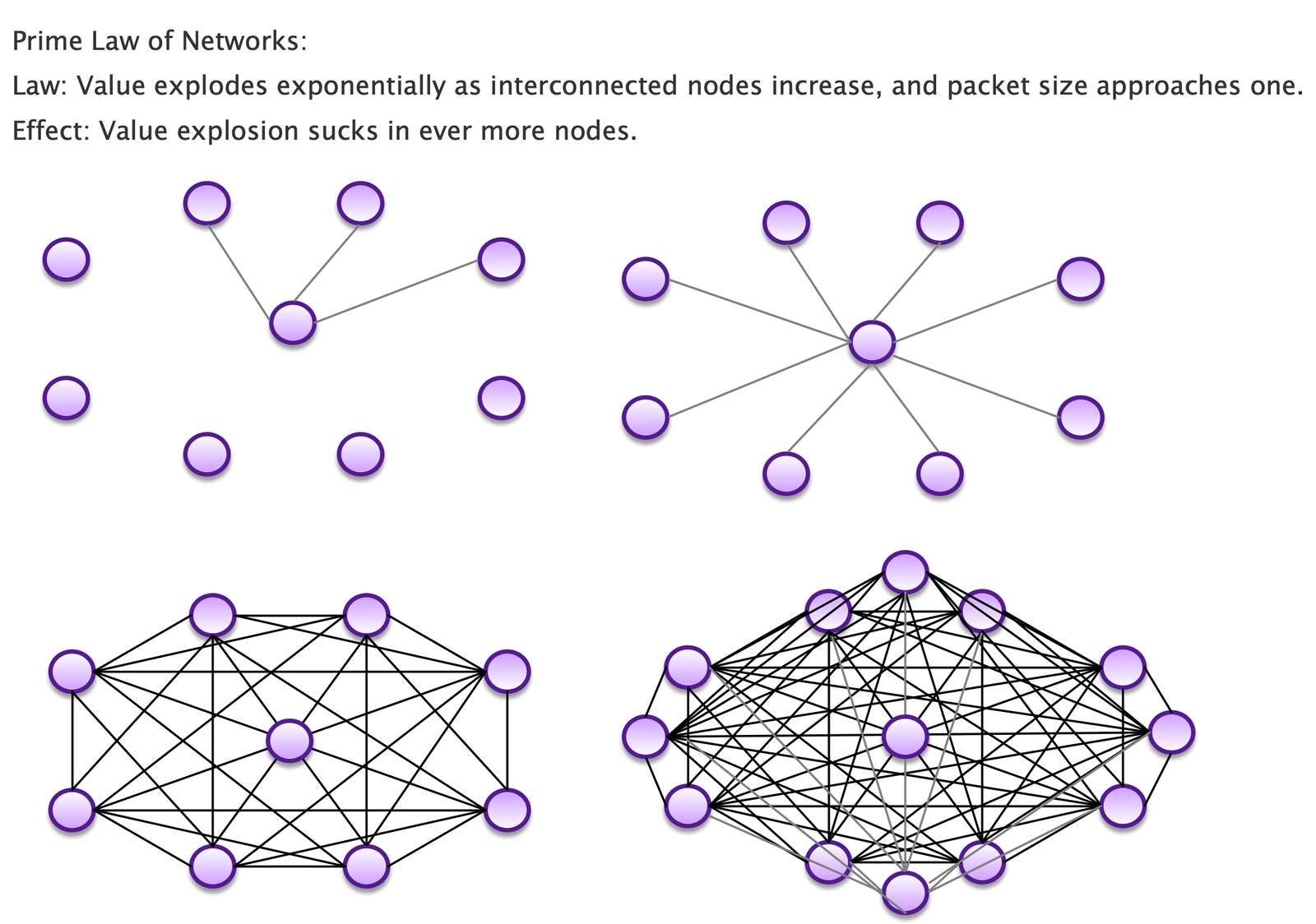
Network value increases exponentially as the number of interconnected nodes increases and the packet size is driven toward one.

Network value explodes exponentially with membership — 7 nodes sparse, 7 nodes connected, 12 nodes, 16 nodes
"Value explodes exponentially with membership, while this value explosion sucks in more members."

Why n²?

Every new node connects to every existing node. 7 nodes = 21 connections. 16 nodes = 120 connections. Double the nodes, quadruple the value. This is Metcalfe's Law — proven by telephones, fax machines, the internet, and social networks.

Why 1/p?

Physical networks have a constraint information networks don't: mass. A highway moves 2-ton packets. A bus batches 40 people into 20-ton packets. The larger the packet, the more you need schedules, fixed routes, and batching — which means most origin-destination pairs can't be served. Drive packet size toward 1 and every O-D pair becomes possible.

The S-Curve Cascade

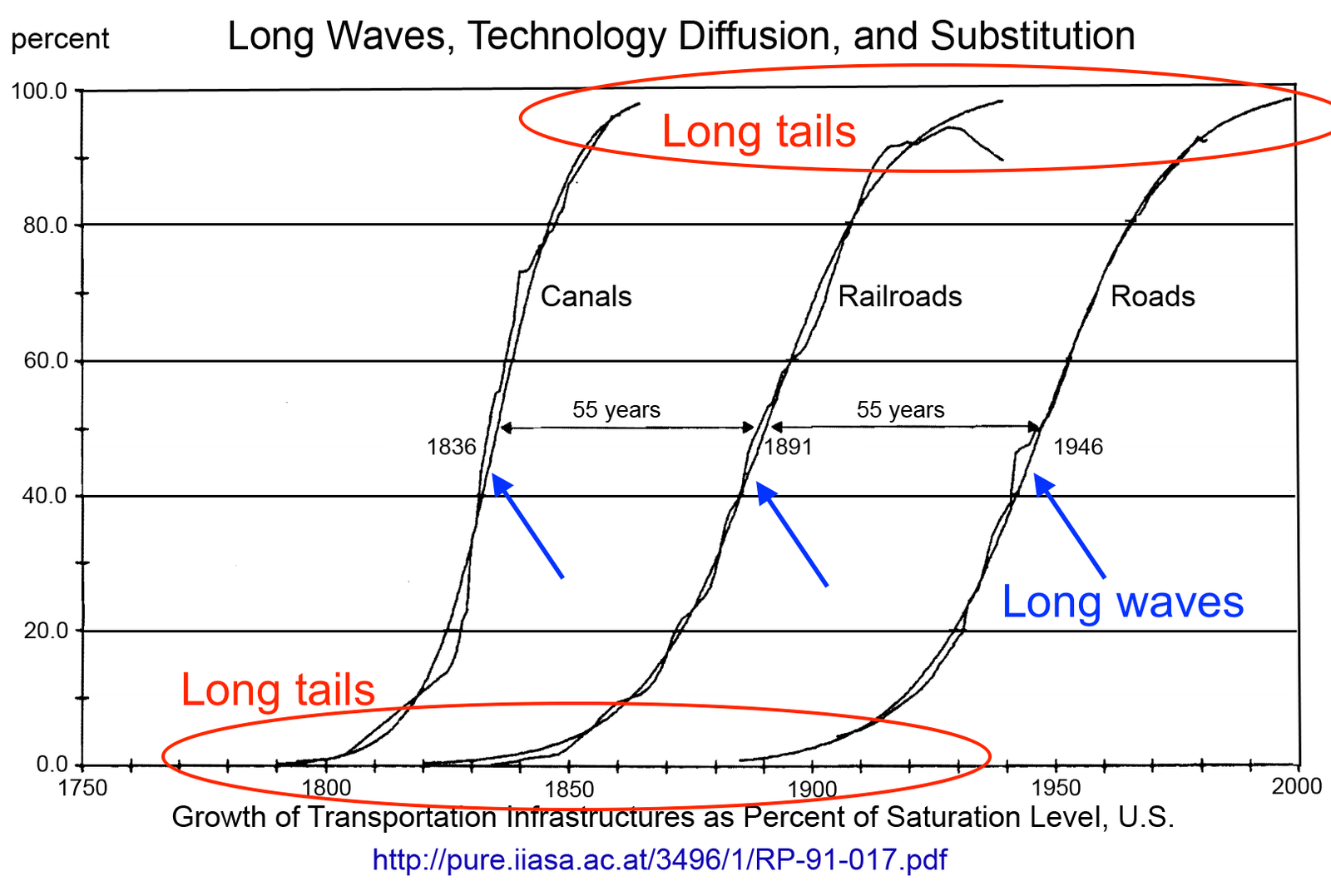
Every transportation infrastructure follows the same pattern: long tail, explosive growth, saturation. The waves come every 55 years. Canals (1836), Railroads (1891), Roads (1946). The next wave is due.

Long Waves, Technology Diffusion, and Substitution — Canals, Railroads, Roads — 55-year intervals
Growth of Transportation Infrastructures as Percent of Saturation Level, U.S. — Source: IIASA RP-91-017
1836
Canals
Barges — 100 tons
1891
Railroads
Trains — 1,000 tons
1946
Roads
Cars — 2 tons
2001+
Guideways
Pods — 500 kg

The internet won by routing small packets dynamically instead of dedicating circuits. JPods does the same thing to physical transportation. Circuit-switching lost to packet-switching. Scheduled transit will lose to on-demand pods.

The Regulatory Century

The internet and personal rapid transit were both invented in the same era. Both required a century to break through government monopolies. One succeeded in 1982. The other is still waiting.

Communications: 64 Years

1918: Executive Order monopolized communications.
1982: Federal courts declared the monopoly unconstitutional.
Result: The internet went commercial. In 25 years, more value was created than in all prior history of communications.

Transportation: 110 Years and Counting

1916: Federal-Aid Highway Act removed efficiency as a market force.
1936: Rural Electrification Act killed 600,000 windmills.
2026: Still waiting.
Cost: Climate change. Oil wars since 1991. $6.4 trillion in Iraq/Afghanistan. 1.8 million highway deaths.

The Parallel Timeline

1916
Federal-Aid Highway Act — Federal government enters road building. Efficiency eliminated as a market force. Nearly half of U.S. freight railroads eventually abandoned (railroads average 476 ton-miles per gallon). Transport
1918
Executive Order monopolizes communications — Government takes control of telephone and telegraph networks. Innovation frozen for 64 years. Comms
1926
Nikola Tesla predicts wireless global connectivity — In Collier's magazine. The technology existed. The monopoly blocked it. Comms
1936
Rural Electrification Act — Mercantile energy monopoly eliminates distributed energy industry. In 1935, the wind industry was building 80,000 windmills a year and 50% of U.S. electricity came from renewables. 600,000 windmills abandoned in favor of centralized coal-burning power plants. Energy
1942
Hedy Lamarr patents WiFi/Bluetooth technology — Navy rejects it. Not adopted until 1957-62. Comms
1956
Federal-Aid Highway Act of 1956 — Interstate Highway System. The largest infrastructure monopoly in history. Automobile dependency locked in for 70 years. Transport
1968
Mother of All Demos — Doug Engelbart demonstrates the mouse, hypertext, video conferencing, and collaborative editing. The internet demonstrated — 14 years before deregulation allowed it. Comms
1972
Morgantown PRT opens — Personal Rapid Transit. Opened by President Nixon's daughter. "More fun than Disneyland." Zero injuries. 150 million+ trips. Congressional study: government "institutional failures" blocked deployment for "four to six decades." Transport
1982
Federal courts declare communications monopoly unconstitutional — AT&T broken up. The dam breaks. Comms
1983
TCP/IP on ARPANET. AOL investment begins. — Within one year of deregulation, the commercial internet starts. Comms
1991
Internet transferred to commercial control — High Performance Computing Act. Also the year U.S. oil imports exceeded domestic production. Oil wars begin. Comms Transport
2001
JPods founded — US Patent 6,810,817: "A method of controlling a transportation System… using a distributed network of intelligent devices without requiring the aid of a human driver." Solar-powered. Transport
2007
iPhone — First digital phone on a digital network. 25 years after deregulation, the communications S-curve reaches saturation. Comms
2026
The transportation monopoly has not been broken. The technology exists. The economics work. Morgantown proved it in 1972. The barrier is regulatory, not technical. Transport
The Boston Tea Party and the Revolutionary War led the Framers to forbid the Federal government from repeating the King's transportation monopoly. Article I, Section 8 reserves internal improvements to the states. The Federal-Aid Highway Act of 1916 violated this principle. The 5X5 Standard restores it — privately funded networks, state-governed, 5x more efficient than roads, for 5% of gross revenues.

The Boston Tea Party was a non-violent demonstration against the general government's mercantile transportation monopoly that triggered a war. To prevent rebuilding that path to war, the Framers voted 8 states to 3 to forbid federal highways, canals, and other “internal improvements” that might mix federal war-powers with commercial self-interest. Oil wars in Iraq and Afghanistan caused by federal highway foreign oil addiction underscore the wisdom of the Divided Sovereignty of the Constitution. The Framers understood that whether monopolies are created by nobility or levelers (their words for right and left), the same defect of government central planning undermines the Wisdom of the Many. The 1916 Highway Act and the 1936 Rural Electrification Act were progressive programs. Today, conservatives defend them while attacking the free-market renewables and transit alternatives that would replace them. The defect is structural, not partisan. Central planning overrides the sorting mechanism — customers choosing, innovators competing, bad ideas failing fast — that networks require to find value. Restore the liberty to innovate and the Wisdom of the Many will drive the S-curve.

— The mercantile blind spot

Start Small → Iterate Relentlessly

You don't build a network all at once. You start with a few nodes, prove value, and let n² do the recruiting. Each new node makes every existing node more valuable. The S-curve isn't planned — it's triggered.

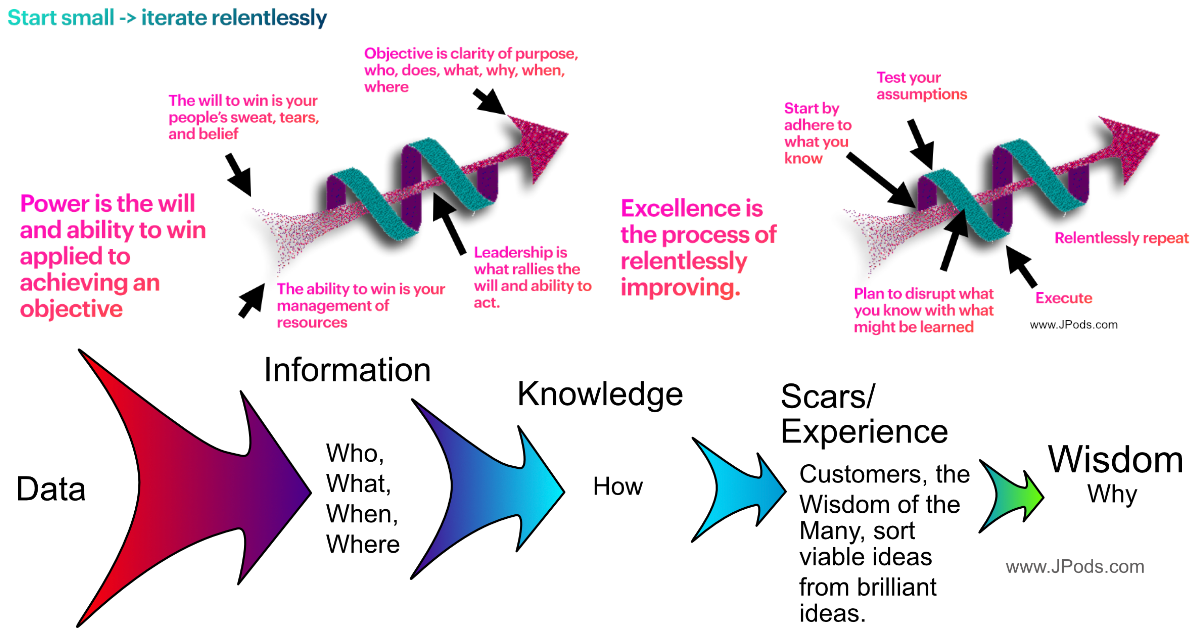
Start small, iterate relentlessly — Power, Leadership, Excellence, Data to Wisdom chain
Excellence is the process of relentlessly improving. Data → Information → Knowledge → Scars/Experience → Wisdom.

The Trigger

One working JPods network in one city. Measurable savings. Visible pods moving above the street. That's the first node. The second city sees it working and asks for one. Now you have two nodes and four connections worth of political proof. By the fifth city, the S-curve is underway.

The Gravity Well

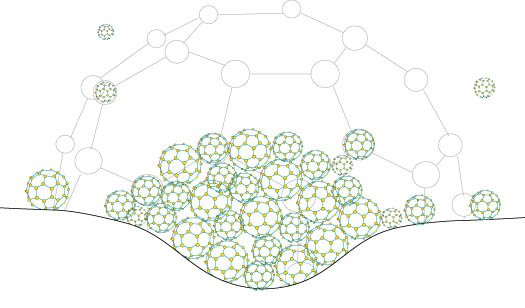
Once a network reaches critical mass, value pulls in new members faster than you can build for them. This is the gravity well effect — the network's own value becomes the sales force. Telephones did it. The internet did it. Social media did it. Physical transit networks will do it when packet size drops low enough.

Gravity well effect — nodes pulled into the network as value increases
The gravity well: once value exceeds the cost of joining, nodes fall in.

Why JPods?

JPods is the only transit system designed from the Prime Law. Every design choice drives p toward 1 and maximizes n.

500 kg
Packet size (pod)
On demand
No schedules
Solar
Net energy producer
5×5
Standard
Small packets
500 kg pods
On-demand routing
Every O-D pair
More value per node
n² unlocked
More nodes join
Gravity well
S-curve cascade
Infrastructure shift

Highways move 2-ton packets on schedules set by traffic. Buses batch 40 people into 20-ton packets on fixed routes. Trains batch hundreds into 100-ton packets on steel rails. JPods moves 500-kilogram packets on-demand to any destination on the network. That is the difference between circuit-switching and packet-switching applied to physical movement.

The Pattern Repeats

Every industry that shifted from large batches to small packets saw the same S-curve explosion.

Information

Before: Mainframes → dedicated circuits → batch processing.
After: PCs → packet-switching → the internet.
Result: More value created in 30 years than in all prior history.

Commerce

Before: Department stores → big inventory → fixed locations.
After: E-commerce → single items → any address.
Result: Amazon ships individual items to every doorstep. Packet size = 1.

Energy

Before: Central power plants → massive generation → long transmission.
After: Solar panels → distributed generation → local consumption.
Result: Energy packet size approaching one rooftop.

Transportation

Before: Trains → buses → highways → schedules → fixed routes.
After: JPods → 500 kg pods → on-demand → any O-D pair.
Result: The next S-curve. Due since 2001.

See the Numbers

Run the Prime Law on your city. See what happens when packet size drops to 500 kg and every node connects to every other node.